
A documented case study on what happened when a small business tried to leave VMS Data — and what we built from the wreckage.
There’s an unspoken agreement in the SEO industry: when a client leaves, you hand over their assets and move on. The website, the logins, the Search Console access — those belong to the business, not the agency. It’s basic professionalism.
VMS Data, a Phoenix-based SEO agency, apparently didn’t get that memo.
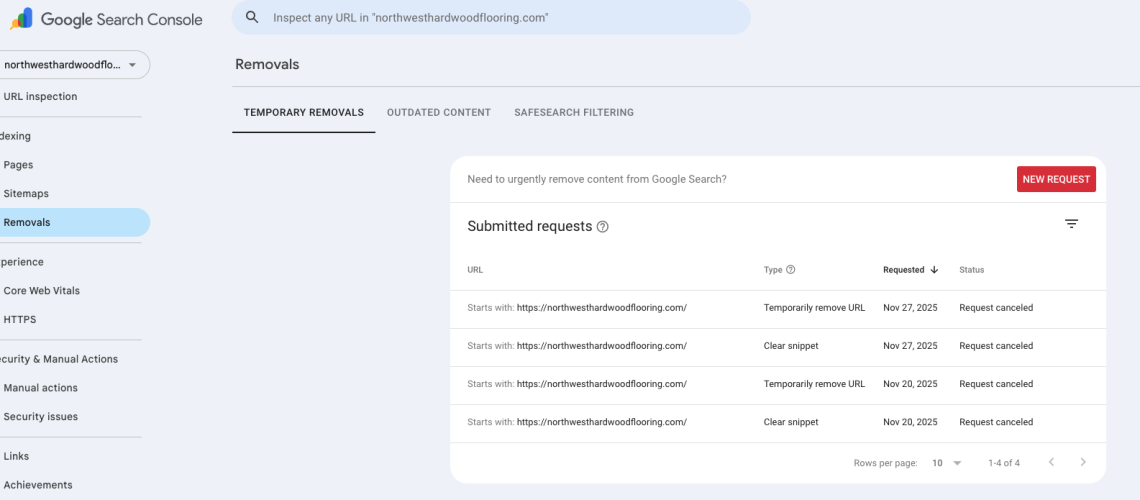
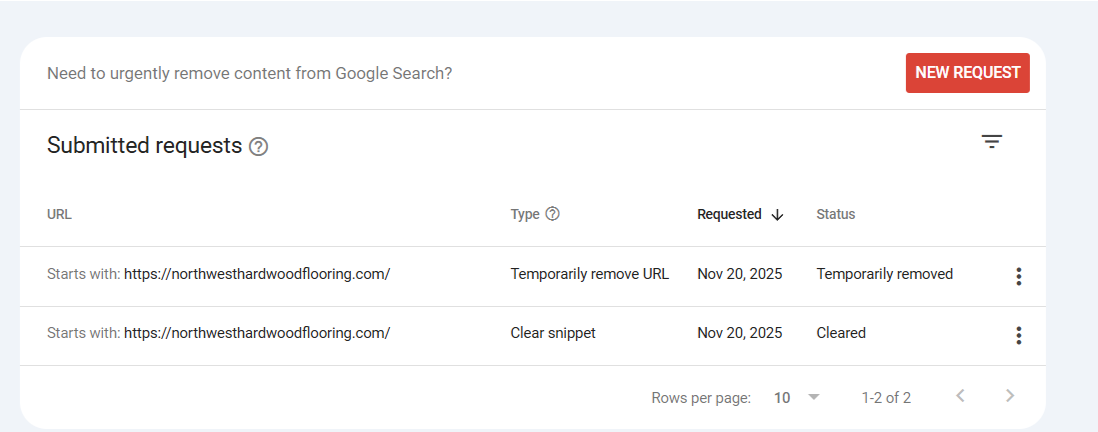
When a hardwood flooring contractor on Washington’s Olympic Peninsula cancelled their SEO services with VMS Data in November 2025, what followed wasn’t a professional transition. It was retaliation. On November 20, 2025 — after the client had already cancelled — VMS Data submitted two requests through Google Search Console: a URL removal request to delist the entire site from Google, and a snippet removal to suppress how the site appeared in search results.
When those requests were cancelled, VMS Data came back a week later — on November 27, 2025 — and submitted the exact same two requests again.
Four removal requests. Two dates. All filed after cancellation. All targeting the client’s entire website. All documented and timestamped in Google Search Console.
This post walks through what happened, what we found when we dug into the data VMS Data left behind, and what we were able to accomplish in 90 days once we took over. If you’re a business owner working with an SEO provider, this is what you need to know to protect yourself.
How It Started
The client, a hardwood flooring contractor serving three counties across the Olympic Peninsula, had been paying VMS Data for SEO services. The site wasn’t performing well — but the client didn’t fully understand the extent of the problem until he brought in outside help.
He asked me — a colleague and friend — to add some new pages to the website. A straightforward request. He knew the site needed more content and wanted to start building out service-specific and location-specific pages to better capture local search traffic.
VMS Data refused. They insisted that only they could make changes to the website, and that bringing in outside help would sever the business relationship — which also meant cancelling hosting and requiring a completely new website to be built. They refused to work with anyone else or give the client access to his own site.
Think about that for a moment. A business owner, paying for SEO services on his own website, was told he couldn’t add content to it. And if he tried, he’d lose everything.
That was the breaking point. The client decided to cancel.
What VMS Data Did After the Client Cancelled
What happened next goes beyond poor service. After the client cancelled, VMS Data took the following actions — all documented in Google Search Console with timestamps:
1. Removed the Google Search Console account. VMS Data deleted the client’s Search Console property, wiping out all historical search performance data. Every query, every impression, every click, every position — gone. This is data that belongs to the business, not the agency.
2. Submitted URL removal and snippet removal requests — on November 20, 2025. Google’s URL Removal Tool exists for one purpose: emergency delisting of pages that have been hacked, contain malware, or expose sensitive information. It is explicitly not intended for use against a former client’s legitimate business website. VMS Data used this tool to request that Google temporarily remove the client’s entire site from search results. The request targeted everything starting with https://northwesthardwoodflooring.com/ — the whole domain. They also submitted a “Clear snippet” request the same day, which suppresses how the site’s pages appear in Google search results by stripping out the descriptive text that helps searchers decide whether to click.
3. Did it again — on November 27, 2025. After the first set of requests were cancelled, VMS Data came back exactly one week later and submitted the same two requests a second time: another “Temporarily remove URL” and another “Clear snippet,” both again targeting the entire domain. This wasn’t an accident or a system glitch. This was a deliberate, repeated attempt to remove a former client’s business from Google search results.
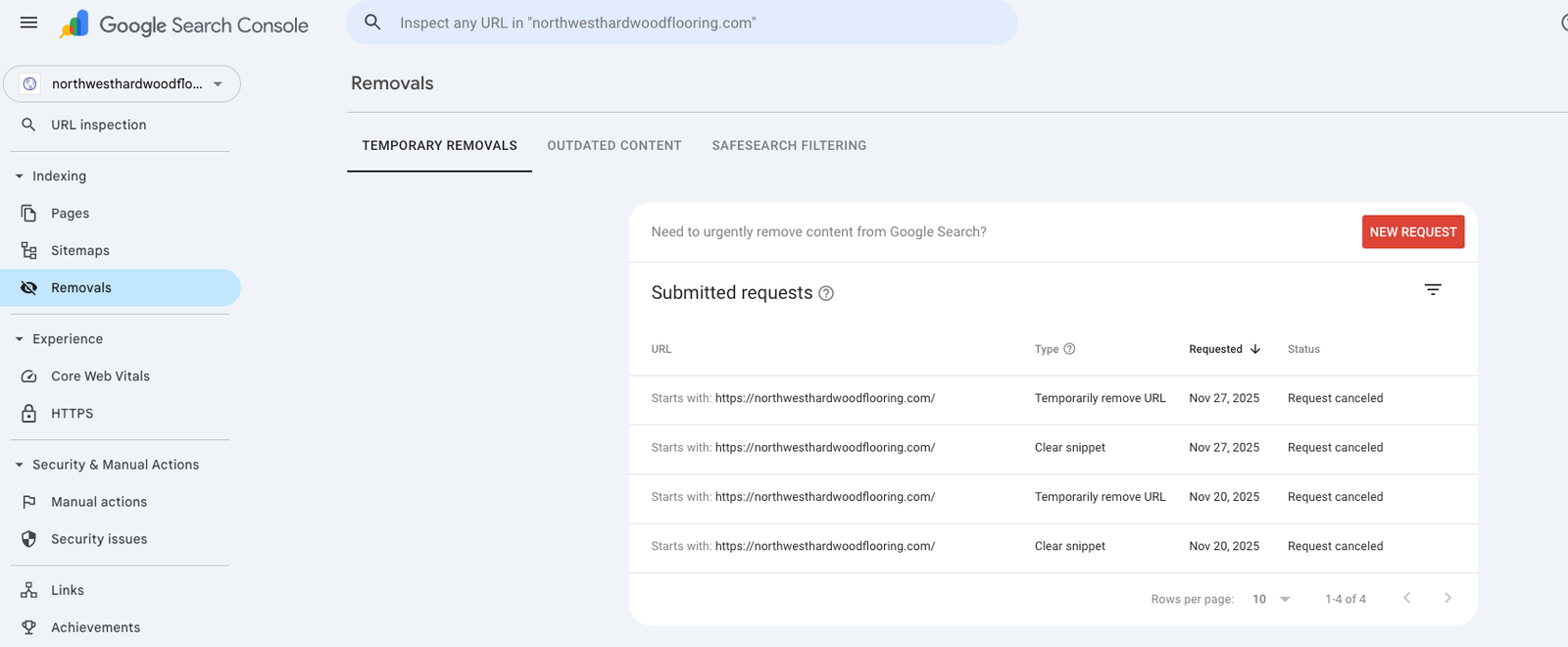
Four total requests. Two separate dates. All filed after the client had already cancelled. The Google Search Console Removals panel shows all four, timestamped and documented.
To be clear: Google’s URL Removal Tool is designed for emergencies — hacked sites, malware infections, exposed personal information. Using it once to punish a client who left is an abuse of Google’s systems. Coming back a week later to do it again is something else entirely.
What We Found in the Data
After re-verifying the domain in Google Search Console, we were able to recover 16 months of historical search data. What it revealed was a site that had been fundamentally neglected from a content and SEO architecture standpoint — despite the client paying for professional SEO services.
Four Pages. Three Counties. No Content Strategy.
Northwest Hardwood Flooring serves Jefferson, Clallam, and Kitsap Counties — a service area covering the Olympic Peninsula, including affluent markets like Bainbridge Island where hardwood flooring projects routinely run $15,000–$50,000+.
Under VMS Data’s management, the entire website had exactly four pages generating any Google Search impressions: the homepage, a contact page, a service areas page, and a single Kitsap County landing page.
No service-specific pages for installation, refinishing, or repair. No location pages for Port Townsend, Port Angeles, Sequim, or Bainbridge Island. No blog content. No FAQ pages. For a business paying for professional SEO services, this is a fundamental failure to build the content architecture that drives local search visibility.
And it gets worse. When we analyzed the homepage content VMS Data had built, we found the business name “Northwest Hardwood Flooring” repeated nearly 20 times across a handful of short paragraphs. This is textbook keyword stuffing — an outdated tactic from the early 2010s that Google has explicitly penalized for years. It doesn’t help rankings. It hurts them.
The Numbers Don’t Lie: 16 Months Under VMS Data
Here’s what the recovered Search Console data showed across VMS Data’s management period:
| Metric | Value |
|---|---|
| Total Queries Appearing For | 868 |
| Total Clicks | 160 |
| Total Impressions | 25,712 |
| Click-Through Rate | 0.62% |
| Pages in Search Results | 4 |
| Referring Domains (Backlinks) | 15 |
A 0.62% click-through rate means that for every 161 times the site appeared in a Google search result, someone clicked once. The typical benchmark for local service businesses is 3–5%. The site was visible enough for Google to show it, but ranked so poorly for Discovery Keywords that almost nobody clicked. Almost all clicks and traffic were built on the brand, and not keywords that drove new customers.
Thousands of Revenue-Driving Searches — Completely Missed
The most telling evidence was in the zero-click queries. These are searches where Google showed the site in results, but the ranking position was so deep that no one ever clicked through:
| Query | Impressions | Clicks | Avg Position |
|---|---|---|---|
| hardwood flooring washington | 849 | 1 | 34.5 |
| hardwood floor contractors | 388 | 1 | 58.0 |
| floor installation near me | 292 | 0 | 25.7 |
| hardwood flooring near me | 289 | 0 | 23.3 |
| hardwood floor refinishing near me | 176 | 0 | 20.6 |
| hardwood floor contractors near me | 55 | 0 | 66.1 |
Position 23 means page 3 of Google. Position 58 means page 6. Nobody scrolls that far. These are people actively searching for hardwood flooring services — potential customers ready to hire — and VMS Data’s strategy had the site buried where no one would ever find it.
The location-specific queries painted an even bleaker picture. “Flooring port townsend” generated 407 impressions with zero clicks at position 45. “Flooring sequim” had 385 impressions, zero clicks. “Flooring port angeles” — 335 impressions, zero clicks. These are the business’s core local markets, and VMS Data had built no content to target any of them.
Fake Traffic Inflating the Numbers
Here’s something every business owner should know to check. The 2024 Google Analytics data showed 944 referral sessions — which might look impressive on a dashboard. But look at where that traffic came from:
news.grets.store— 493 sessionsstatic.seders.website— 174 sessionsrida.tokyo— 124 sessionskar.razas.site— 42 sessionsinfo.seders.website— 42 sessions
These are spam referral domains. They generate fake visits that inflate your traffic numbers while delivering exactly zero real customers. A competent SEO provider would filter these out and flag them. At minimum, they shouldn’t be counted as performance.
Strip away the spam, and the actual Google traffic was just 338 sessions for the entire January through November 2024 period. That’s roughly 31 legitimate Google visitors per month — for a business paying for professional SEO.
What We Did in 90 Days
When we officially took over in November 2025, the first order of business was damage control. We re-verified the domain in Google Search Console — which is how we discovered and documented the removal requests VMS Data had filed. We then began building the content architecture that should have existed from day one.
Our strategy was built on three pillars, all driven by what the recovered search data told us:
1. Service Page Expansion. We created four comprehensive service pages: Hardwood Floor Installation, Sanding & Refinishing, Repair & Maintenance, and Floor Preparation & Trim. Each page included detailed service descriptions, FAQ sections targeting real customer questions, review sections for social proof, and clear calls-to-action. This is the baseline content every service business needs — and VMS Data had never built it.
2. Location-Specific Landing Pages. The Search Console data made it obvious that location searches were the single biggest missed opportunity. We built dedicated pages for Bainbridge Island, Port Angeles, Port Townsend, and Sequim — the exact markets where the data showed hundreds of impressions and zero clicks.
3. Content Marketing. We developed blog content targeting educational queries that feed the conversion funnel: “Refinish or Replace: Making the Right Decision,” “What Is Dustless Refinishing?” and others designed to establish topical authority and capture informational searches.
The Results
The turnaround was measurable almost immediately — and it accelerated as new content was indexed.
Month-Over-Month: December 2025 vs. January 2026
| Metric | December | January | Change |
|---|---|---|---|
| Total Clicks | 25 | 50 | +100% |
| Total Impressions | 2,196 | 3,630 | +65% |
| Click-Through Rate | 1.14% | 1.38% | +21% |
| Average Position | 26.8 | 24.2 | Improved 2.6 spots |
Year-Over-Year: 2024 vs. 2025
| Metric | 2024 | 2025 | Change |
|---|---|---|---|
| Organic Search New Users | 307 | 493 | +60.6% |
| Organic Search Sessions | 384 | 623 | +62.2% |
| Homepage Google Impressions | 5,656 | 26,319 | +365% |
| Google Sessions | 338 | 548 | +62.1% |
From 4 Pages to 18 — With Page 1 Rankings
Under VMS Data, four pages appeared in search results. By January 2026, 18 pages were generating impressions, and several were already on page 1:
| Page | Impressions | Avg Position |
|---|---|---|
| Floor Repair & Maintenance | 142 | 2.7 |
| Floor Preparation & Trim | 94 | 2.5 |
| Bainbridge Island | 88 | 10.8 |
| Port Angeles | 85 | 13.9 |
| “Refinish or Replace” Blog Post | 88 | — |
| Sequim | 63 | 7.0 |
| “Dustless Refinishing” Blog Post | 63 | 7.9 |
| Hardwood Floor Refinishing | 55 | 10.6 |
The standout win: the query “flooring port townsend” moved from position 45 (zero clicks) under VMS Data to position 8.8 with its first click — a 37-position jump. That’s what happens when you actually build a page targeting the searches people are making.
It’s Not Just Us — A Pattern of Retaliatory Behavior
What happened to our client is not an isolated incident. Within weeks of our experience, another former VMS Data client posted a public review describing an almost identical situation:
“What makes this even worse is the way VMS Data responded when they learned we were migrating our domain to a new provider. They went out of their way to complicate the process and even removed the site from Google’s index, causing immediate damage to our online visibility. This appears to have been done in direct reaction to our choice to leave their service, and the result was unnecessary work, delays, and harmful impact on our business’s digital presence.”
“Even after canceling all services and products — with documentation confirming those cancellations — we continued to receive charges for services we no longer authorized or used. We were forced to dispute these charges manually.”
The review describes VMS Data’s pricing as “predatory” and their communication as “unprofessional, aggressive, and dismissive.” It also details unauthorized charges continuing after cancellation — charges the former client had to manually dispute.
Two different businesses. Two different industries. Two different parts of the country. The same retaliatory playbook: client leaves, VMS Data removes the site from Google’s index.
This isn’t a one-time mistake. It’s how they operate.
What Every Business Owner Needs to Know
This case isn’t just about one bad SEO provider. It’s a cautionary tale with specific lessons for any business paying for SEO services.
Protect Your Google Properties
You must have independent, owner-level access to your own Google Search Console and Google Analytics. Not editor access. Not viewer access. Owner. If your SEO agency set up these properties under their own account, they can remove your data — and your site from Google — at any time. Ask today whether you have owner access. If you don’t, fix it immediately.
Own Your Website
If your SEO provider won’t give you access to your own website, or tells you that bringing in outside help will “sever the business relationship,” that’s a hostage situation, not a partnership. You should always have admin-level access to your CMS, your hosting account, and your domain registrar. If any of those are locked behind your agency’s credentials, you are at their mercy.
Know What Removal Tools Are — And Watch for Abuse
Google’s URL Removal Tool and snippet suppression features exist to protect site owners from security threats like malware and hacked content. They temporarily delist pages from Google search results. If you’ve recently left an SEO provider and noticed a sudden drop in your Google visibility, log into Search Console, navigate to Removals under the Indexing menu, and check for requests you didn’t authorize. If you find them, report the abuse to Google.
Verify Your Traffic Is Real
Log into Google Analytics and look at your traffic sources. If you see referral traffic from domains you don’t recognize — especially ones with unusual extensions like .store, .website, .tokyo, or .site — that’s almost certainly spam. If your SEO provider is counting that as performance, they’re either incompetent or dishonest.
Demand Content, Not Excuses
If you offer multiple services across multiple locations and your website has fewer than 10 pages appearing in Google, your SEO provider isn’t doing their job. Every core service and every primary location in your service area should have its own dedicated, optimized page. Four pages for a three-county service area is not a strategy — it’s neglect.
Look at Position, Not Just Impressions
An SEO provider who shows you “10,000 impressions” without telling you the average position is hiding the truth. Impressions on page 5 of Google are worthless — nobody scrolls that far. Demand position data. If your average position is above 20 for your target queries, you’re invisible to the people searching for your services.
The Bottom Line
VMS Data managed this client’s SEO and produced a site with four indexed pages, a 0.62% click-through rate, keyword-stuffed content, 15 backlinks, thousands of missed local search opportunities, and spam referral traffic inflating the numbers. They refused to let the client add content to his own website and refused to give him access to it. When he cancelled, VMS Data removed his Search Console property and filed URL removal requests and snippet removals against his entire domain — first on November 20, 2025, and then again on November 27, 2025, when the first attempt was cancelled. Tools designed to protect hacked sites, weaponized against a small business. Not once, but twice.
And they’ve done it to at least one other business that we know of.
Within 90 days of taking over, we expanded the site from 4 pages to 18, doubled monthly clicks, grew Google impressions by 365% year-over-year, and landed multiple new pages on the first page of Google — including service pages at positions 2.5 and 2.7.
Every claim in this post is backed by documented data in Google Search Console and Google Analytics. The removal requests are timestamped. The spam traffic sources are logged. The zero-click queries are on the record. The screenshots are included below.
If any of this sounds familiar, or if you’re not sure whether your current SEO provider is delivering real results, we offer free SEO audits. We’ll walk you through your own Search Console data and show you exactly where your site stands. No sales pitch — just data.
Honestly, it took a lot to call out a company like this, but they really deserved it. I am targeting their brand name with this search in the hopes that their future clients see it and maybe some of their current clients. Please don’t get taken advantage of by this company. If you have any questions please contact us and we can show you exactly how we can improve your site traffic and get real qualified customers from SEO.